How to flatten a rug before photographing it
Folds, ripples and curled corners ruin rug photos. Practical ways to flatten a rug before a shoot, plus what to do when there is no time to wait.
Drafted with AI assistance from Larina's own guides and the sources listed, then checked by automatic quality rules.
This article is available in English only.
Ask an AI assistant about this article
Open ChatGPTOpen PerplexityOpen ClaudeOpen CopilotOpen Gemini
These links only open the service. Some may fill the request in; if the box is empty, paste it.
Quick answer
To flatten a rug for photos, reverse roll it for a while, walk it flat on a hard floor, and weigh the corners just outside the frame. Stubborn folds need time: leave the rug flat under even weight for a day or two. If it still ripples, hang it or pick a forgiving angle, and mention any permanent fold in the listing.
Why do creases and ripples hurt rug photos?
Creases and ripples make a rug look worn, distort its pattern and hide its real shape. Shoppers judge a rug from your pictures, so every fold in the photo becomes a question in their mind.
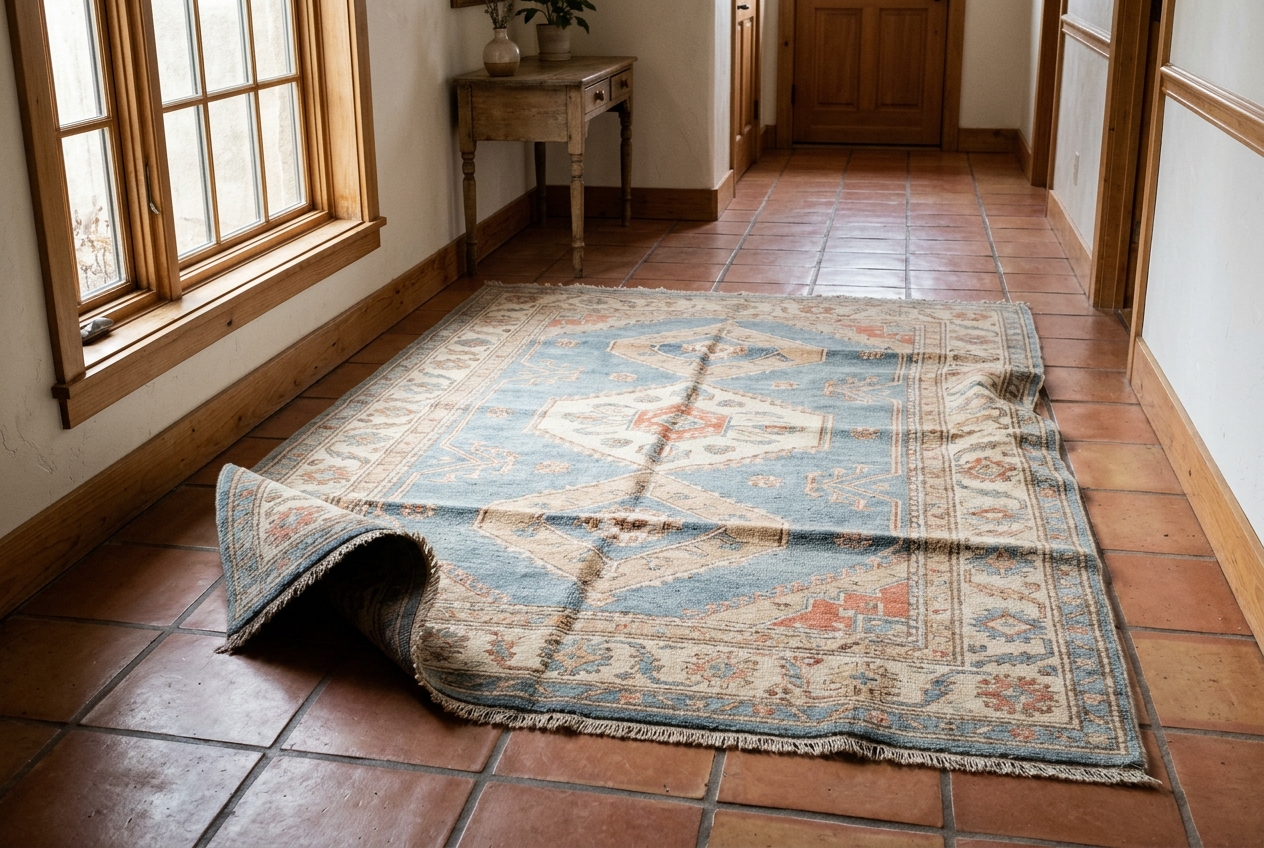
Folds read as damage. A sharp storage crease looks a lot like a weak line in the foundation. A shopper cannot touch the rug, so they cannot tell a temporary fold from a real fault. Some will simply scroll past.
Ripples catch light. A wave in the pile tilts part of the surface towards the window and part away from it. That creates light and dark stripes across the pattern. The stripes can look like fading or uneven dye, even when the colour is perfect.
Curled corners hide the shape. A rug with lifted corners looks smaller and less square than it is. Curl also hides the binding and the edge finish, which careful buyers want to see.
Light direction matters too. Low light from the side is called raking light, and it emphasises surface topography and texture "through the creation of shadows" [5]. Conservators use it on purpose because it "can amplify the appearance of indentations, undulations" and textile weaves [5]. For a sales photo, that means a low sun across a rippled rug will make every wave louder.
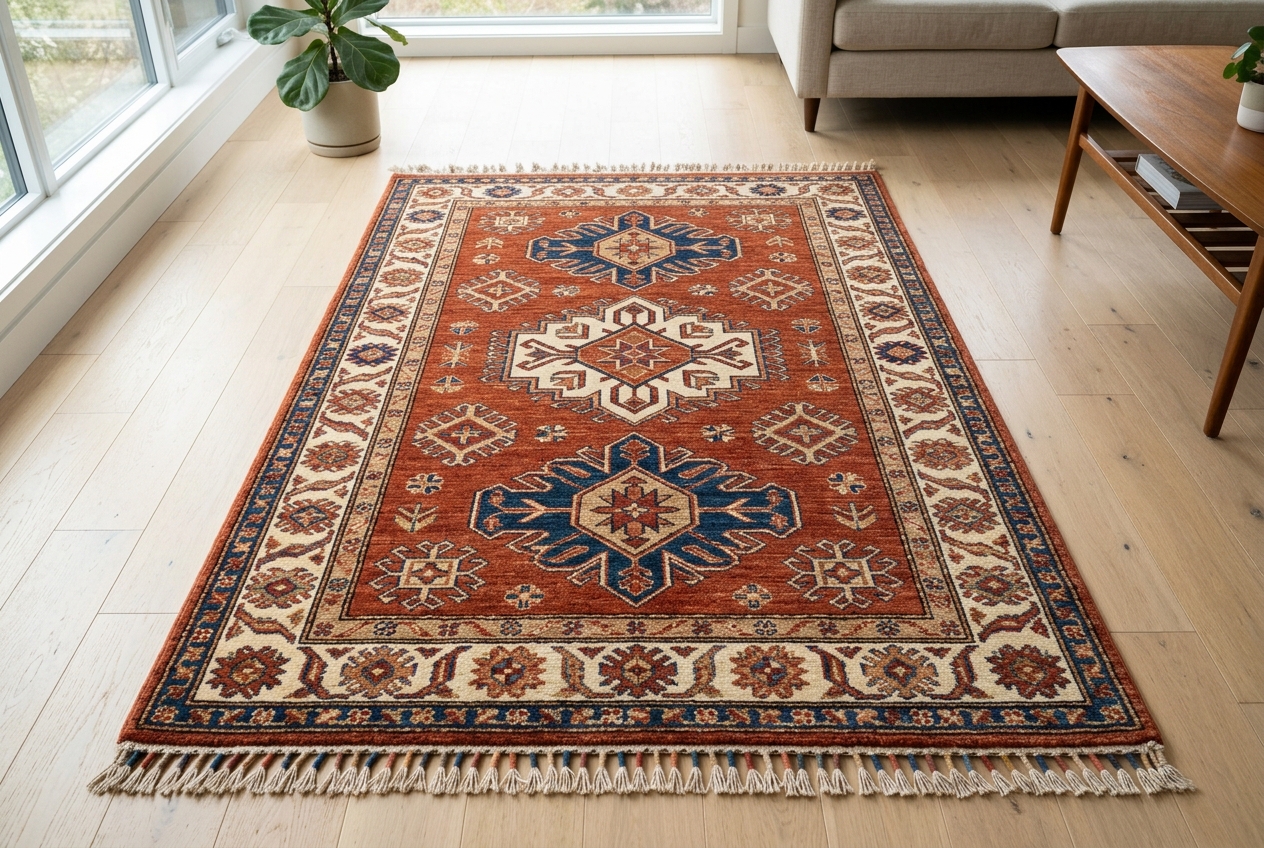
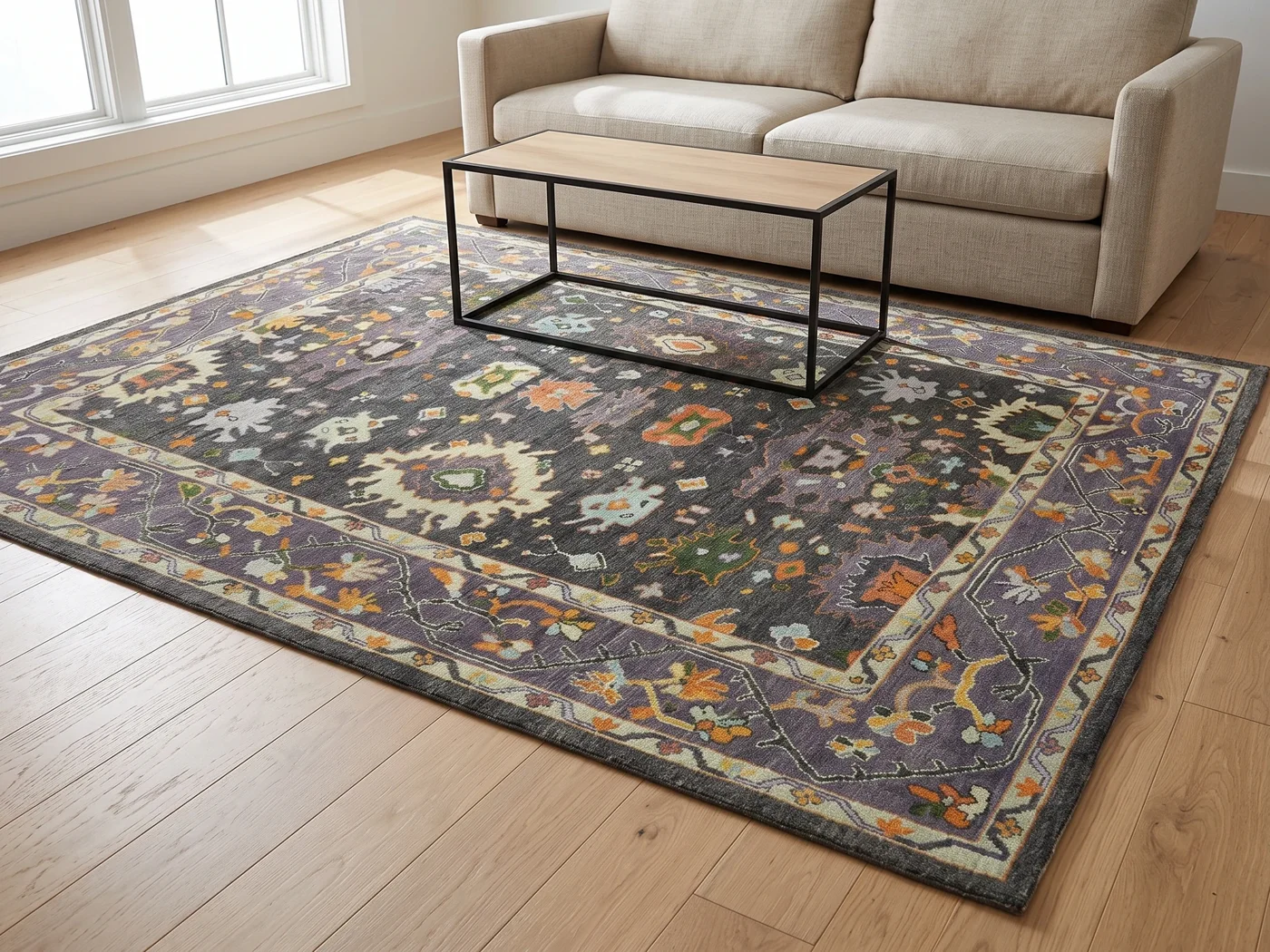
The pair above is an AI illustration, not a photo. The left image shows a flat rug with straight edges and corners that stay down. The right image shows two fold creases, a ripple along one side and a curled corner, which is the kind of surface that makes a shopper hesitate.
What are the quick fixes on the day of the shoot?
On a shoot day, reverse roll the rug, walk it flat and weigh the corners outside the frame. These three steps are a general approach that can often ease mild curl and soft ripples while you set up your camera.
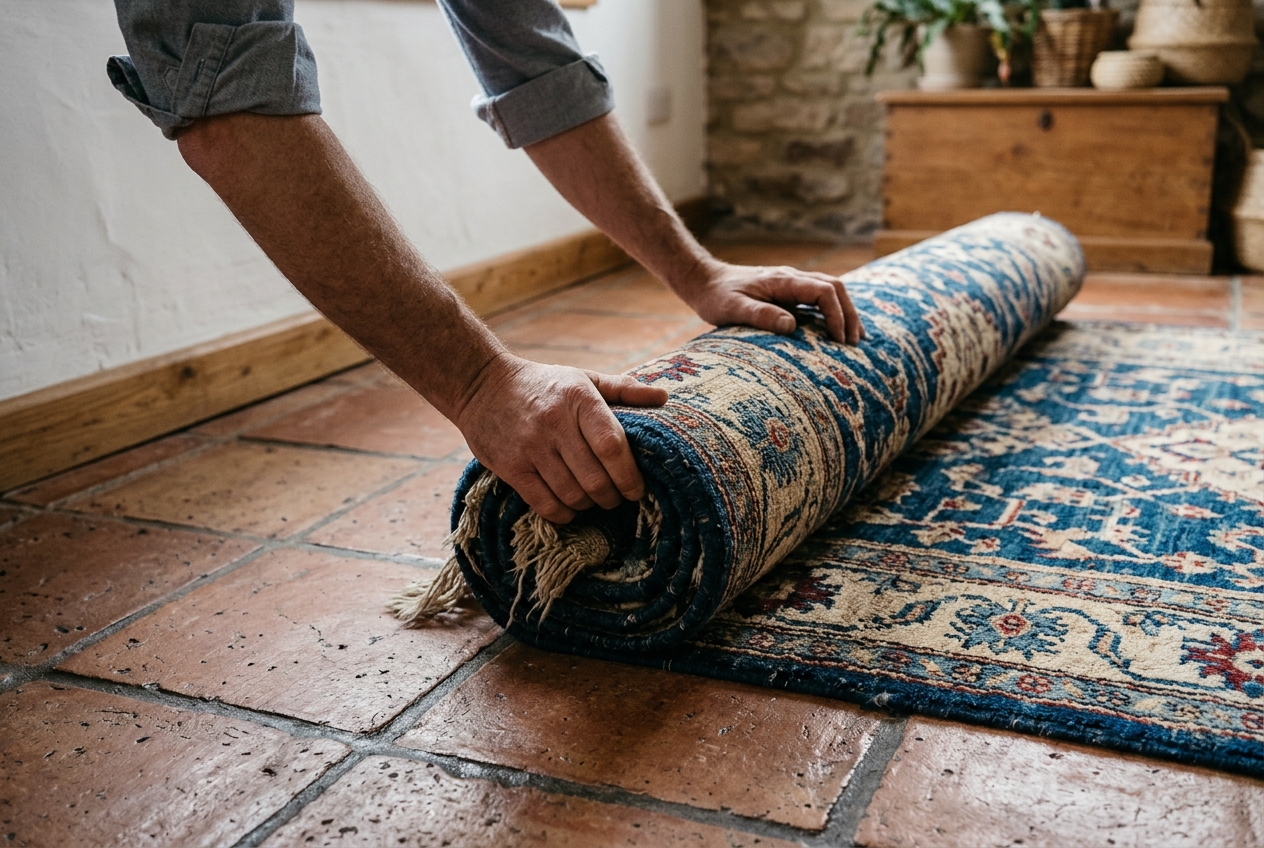
The illustration above shows the first step: both hands rolling the rug the opposite way, with the pile facing out, on a tiled floor.
Reverse roll for a short while
Curl comes from the direction the rug was stored. Roll it the opposite way, pile facing out if it was rolled pile in, and leave it rolled while you prepare the room. Then unroll it and see how the edges sit. Repeat once if the ends still lift.
Weigh the corners down
Place heavy books, or anything flat and stable, on each corner. Set them on the very tip of the corner or just beyond the edge you will crop. Leave them while you set the lights. Take them away just before you shoot, or frame so they sit out of view.
Protect the pile. Put a clean cloth under anything with a rough or dirty base.
Walk the rug flat
Lay the rug on a hard, clean floor. Walk slowly across it in socks, working from the centre towards each edge. This pushes soft ripples outward until they flatten. Carpet underneath makes this harder, because the rug moves with the soft surface below.
For more on this topic, see our article: Why rug colours shift in photos, and how to keep them true.
How do you fix stubborn folds?
Deep folds need time and even weight, sometimes helped by gentle warmth. If a rug has been folded for months, no quick trick will remove the line on the day.
Leave it flat under even weight
Lay the rug face up on a clean, hard floor. Spread weight evenly along the fold line, not just at one point. Boards with books on top work well, because they spread the load. Leave it for a day or two, then check. A second round is fine if the line has softened but not gone.
Use gentle warmth
Fibres relax more easily in a warm room. A sunny room can help a folded rug settle. Keep it gentle. Long hours of strong direct sun can fade dyes, so turn the rug or move it into indirect light if the sun is fierce.
Avoid extremes. A conservation source warns that "excessive levels of temperature and relative humidity can cause accelerated deterioration" [3]. Warm and dry is your target, not hot and damp.
Is steam safe for a rug?
Steam is risky for many rugs, so treat it as a last resort rather than a quick fix. Check the care guidance for the material first, and test any moisture on a hidden spot before you go further.
Steam is tempting, but moisture is a risk for many rugs. The same source notes that "water damage can ruin colors and weaken supporting fibers" [3]. Some dyes run, some backings shrink and some fibres react badly to heat and water. Always test on a hidden spot first, such as the back of a corner, and wait to see how it dries. For hand-knotted, silk, viscose or antique rugs, or any rug whose dyes may run, call a professional rug cleaner or textile conservator instead. If you are unsure, leave steam out and rely on weight and time.
How do you check a rug is flat before you shoot?
Look at it from the camera position, then from low down, then with the main light on. A rug can look flat when you stand over it and still show waves in the frame.
Work through these checks in order:
- Stand where the camera will be. Look along the rug, not down at it. Ripples show up better at a low angle.
- Crouch at each short end. Sight along the surface like you would sight along a plank. Any hump stands out.
- Turn on your shoot lighting. Look for light and dark bands. These usually mean a ripple, not a colour problem.
- Check all four corners. Each one should touch the floor. Press lightly and see if it springs back up.
- Check the fringe and binding. Straighten fringes with your fingers and make sure the edge runs in a clean line.
- Take a test frame. Zoom in on the screen. The camera often shows what your eye missed.
- Remove weights and props. Make sure nothing is left in the corner of the frame.
This takes a few minutes. It saves you from reshooting a whole collection because of one wave you missed.
What goes wrong when flattening a rug, and how do you fix it?
The usual problems are curl that returns, stripes of light across the pattern and fold lines that stay visible. Each has a simple cause and a simple fix.
Curl that returns usually means the rug was rolled one way for a long time. One reverse roll is not enough. Do it again, and leave weights on the ends for longer.
Light stripes come from small waves, often made worse by low side light. Flatten the rug again, then soften or raise your light. A conservation guide on photographing textiles says photographs can be taken in other lighting situations "to show particular information, such as distortions (raking light)" [4]. In a sales shot, you want the opposite, so keep that low side light away.
| Problem | Cause | Fix |
|---|---|---|
| Corners curl up | Rug stored rolled one way | Reverse roll, then weigh corners outside the frame |
| Light and dark stripes | Small ripples plus low side light | Walk the rug flat, then use softer, higher light |
| Sharp fold line | Rug was folded in storage | Even weight over the fold for a day or two |
| Rug creeps while you walk it | Soft carpet underneath | Move to a hard, clean floor |
| Weights show in the frame | Placed too far inside the edge | Set them on the corner tips, or crop tighter |
| Edges wavy along one side | Uneven binding or long folded edge | Weigh the full edge, or shoot from a forgiving angle |
How should you store rugs so they are ready to photograph?
Roll rugs instead of folding them, unroll the ones due for photos ahead of time, and label every roll. Good storage turns flattening from a chore into a quick check.
Roll, do not fold
Folds leave lines. They can also harm the rug over time. A conservation guide puts it plainly: "Carpets and rugs should not be folded as folds create weak points which will eventually wear and break" [3]. Rolling avoids those sharp lines.
Roll with the pile facing out. This tends to be kinder to the pile and makes reverse rolling on the day easier.
Unroll photo rugs ahead of the shoot
Plan your shoots. When you know which rugs you will photograph, unroll them ahead of time and let them rest flat. Even a night on the floor makes the shoot day far smoother.
Label every roll
Label each rolled rug with what a person needs to find it: a stock code, the rug type and the size in words. Put the label on the outside, where you can read it without unrolling. This stops you unrolling the wrong rug and then rolling it back up, which only adds new curl.
For more on this topic, see our article: Vintage rug condition photos: a seller checklist.
Can you flatten a rug for photos without risking damage?
Yes, if you stick to time, even weight and mild warmth. The risky methods are the fast ones: heavy steam, high heat and sharp weights pressed into one spot.
Safe habits to follow:
- Use a clean, dry, hard floor.
- Spread weight across boards rather than stacking it on one point.
- Keep anything dirty or rough away from the pile.
- Keep the room warm and dry, not hot or damp.
- Never stand heavy furniture legs on a delicate rug to flatten it.
Old and fragile rugs need extra care. A rug with weak areas can split along an old fold if you force it. In that case, flatten what you can, then photograph the fold honestly rather than fighting it.
Moisture deserves special caution. Water can ruin colours and weaken supporting fibres [3], and a stained or shrunk rug is far worse than a rug with a soft crease. Test any heat or moisture on a hidden spot first, and hand silk, viscose, hand-knotted or unstable-dye rugs to a professional. When in doubt, leave the steamer in the cupboard.
What can you do when a rug still will not lie flat?
If a rug refuses to flatten, change how you show it: hang it, pick a forgiving angle, and describe any lasting fold in the listing. Honest photos and words build more trust than a rug that only looked flat in the picture.
Hang it against a wall
Gravity is a strong flattener. Hang the rug from a sturdy rod or batten against a plain wall, with even support along the top edge. Many waves drop out as the rug hangs. This works well for smaller rugs and runners, and shows the full face in one clean view.
Hanging also lets shoppers see the border and the central pattern together, so the rug reads as one object rather than a set of close-up details. Keep the wall plain and the light even, and check the frame for any nail or rod that could distract.
Choose angles that soften minor ripples
Shoot from slightly higher, looking down, rather than from a low angle along the floor. Keep light soft and frontal. Both choices reduce shadow in small waves.
Note permanent folds honestly
Some folds are part of a rug's history. Add a close-up of the fold and a plain line in the description. A conservation guide to documenting textiles lists "overall front and back views" and "details of damage" as standard shots [4]. The same habit helps shoppers, and anyone judging a rug by photo, such as for an appraisal, sees the truth.
For more on this topic, see our article: Turn your rug photo into product images for your store.
Where Larina fits
Larina's /features page lists "Room scenes, close-ups and clean shots from one photo", "A whole rug collection, queued in one go" and "Finished photos straight to your product pages" [1]. Larina's monthly plans start at $49 for 50 photos a month (Pro) [2]. Unused Larina credits do not expire [2]. A flat, well prepared rug gives any photo workflow a better starting point.
Related reading
- Why rug colours shift in photos, and how to keep them true
- Vintage rug condition photos: a seller checklist
- Turn your rug photo into product images for your store
Final takeaway
A flat rug photographs as itself. A creased rug photographs as a question. Your job before the shutter is to remove the question.
On shoot days, use the quick trio: reverse roll, walk it flat on a hard floor and weigh the corners just outside the frame. Then check from the camera position and from low down, with your lights on.
For rugs that arrive folded, plan ahead. Give them a day or two flat under even weight, in a warm, dry room. Treat steam as a last resort, only after checking the care guidance and testing on a hidden spot, and call a professional for delicate rugs.
Prevention beats repair. Roll rugs pile out, never fold them, and label each roll so you unroll only what you need. Unroll the next batch the night before you shoot.
When a rug will not cooperate, hang it, use softer and higher light, and show any lasting fold in a close-up with an honest line in the listing. Clear, truthful photos are the goal for good rug photography.
Frequently asked questions
How long does it take to flatten a rug for photos?
Mild curl often relaxes during a short reverse roll and a walk across the floor. Deep storage folds can need a day or two flat under even weight, sometimes longer for heavy rugs.
Can I iron a rug to flatten it?
It is safer not to. Direct heat and pressure can damage pile, dyes and backings. Use time, even weight and a warm room instead, test on a hidden spot, and ask a professional for delicate rugs.
Should I roll rugs pile in or pile out?
Roll them pile out for storage. It is gentler on the pile and makes the reverse roll on shoot day easier when you need to relax curl.
Why do my rug photos show stripes across the pattern?
Small ripples tilt the pile towards and away from the light, making light and dark bands. Flatten the rug again, then use softer light from higher up rather than low side light.
Is it fine to leave weights in the photo?
No. Weights distract and can look odd in a listing. Place them on the corner tips or just beyond your crop, and remove them before the final frame.
Should I mention a fold that will not come out?
Yes. Show it in a close-up and describe it plainly in the listing. Shoppers can then judge the rug fairly, and you avoid surprises after delivery.
Sources
- Built for products where every detail matters (larina.ai): https://larina.ai/features
- Pricing (larina.ai): https://larina.ai/pricing
- Attics and Basements and Closets, Oh My! Part 7: Rugs and Carpets | Art Conservation Resources (artcons.artsci.udel.edu): https://artcons.artsci.udel.edu/?p=956
- Textile Conservation Catalog, Chapter IV, Section E: Photographic documentation (American Institute for Conservation, Textile Specialty Group): https://www.conservation-wiki.com/wiki/TSG_Chapter_IV._Documentation_of_Textiles_-_Section_E._Photographic_Documentation
- Raking light (American Institute for Conservation, Conservation Wiki): https://www.conservation-wiki.com/wiki/Raking_light